
Upland Wood Flooring handles hardwood floor repair in Upland, CA and has spent more than 20 years fixing wood floors, serving surrounding cities including San Antonio Heights, Claremont, Montclair, Rancho Cucamonga and La Verne. We replace damaged boards, close problem gaps, stop squeaks and repair water, pet and insect damage, keeping as much of the original floor as we can.
Repair starts with finding out why the floor failed. A cupped board, a hollow spot or a dark stain is a symptom, and replacing the boards without fixing the cause means the damage comes back. We check moisture, the subfloor and the fastening before deciding what a repair should involve.
Older floors are worth saving. More than half of Upland’s homes were built before 1980, and many still have their original solid hardwood. Repairing and matching those boards keeps the character of the house and usually costs far less than tearing out a whole room.
Replacing Damaged Boards
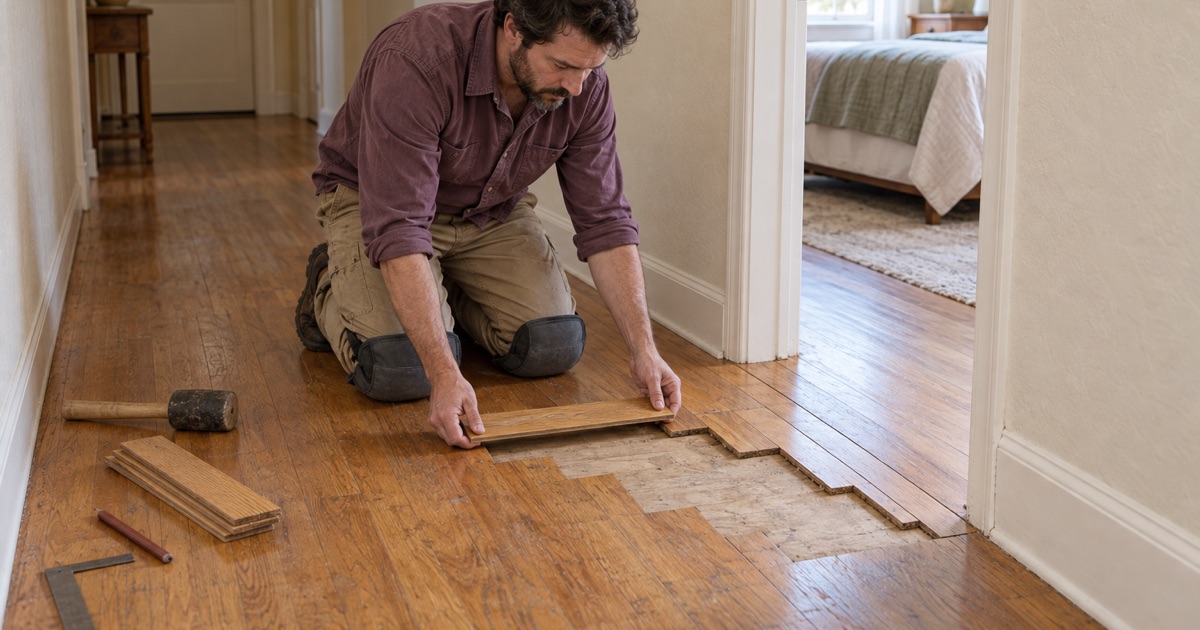
Cutting Out and Weaving In
A damaged board is cut out along its length, and the tongue and groove edges are trimmed so a replacement can slide in. The new board is fitted, glued and fastened so it sits flush with its neighbors. When several boards are affected, we stagger the replacements so the end joints fall at different points, the way the floor was originally laid.
That weaving is what separates a good repair from a patch. A square block of new boards reads as a repair from across the room, while staggered boards disappear once the floor is sanded and finished. We take the extra time because the whole point of a repair is that nobody notices it later.
Matching Species, Width and Cut
A replacement has to match the species, board width, thickness and cut of the original. Red oak and white oak look different once finished, and plain sawn, rift sawn and quartersawn boards show different grain patterns. Getting any of those wrong makes a repair stand out, however well it is fitted.
For older floors, we source boards to match or use salvaged boards taken from a closet or under a built-in. New boards then go into the hidden spot. That keeps the visible repair in original wood that has aged the same way as the rest of the room.
Blending the Finish
New boards and old finish rarely match on their own. After a repair, we sand and finish either the whole room or a full run of boards so the color and sheen level are even. Stained floors get stain samples on the new boards first so the repair takes the same color.
Where a full refinish is not planned, we can often blend a repair into a floor that is otherwise sound by screening and recoating the surrounding area. We explain which approach suits your floor before the work starts, so you know what the finished repair will look like.
Gaps, Squeaks and Hollow Spots
Board Gapping
Solid hardwood shrinks when indoor air is dry and swells when it is humid, so small gaps that open and close with the seasons are normal. Filling those gaps usually fails, because the filler cracks out when the boards swell again. For seasonal gapping, steadier indoor humidity is the better answer.
Permanent gaps are different. They can come from boards laid without proper acclimation, a subfloor problem or past water damage. Depending on the width, we fill them with wood filler, glue in slivers of matching wood, or replace a run of boards and relay them tight.
Squeaks and Soft Spots
A squeak usually means boards rubbing against each other or against loose nails, or a subfloor that has pulled away from the floor joists. On a raised floor, we fix squeaks from below where we can reach, adding fasteners or shims between the joists and the subfloor.
Where the underside is not reachable, we refasten from above and conceal the fasteners. A soft spot is more serious, since it can mean damaged subfloor or a weakened joist. We open the area if needed and repair the subfloor before refastening the boards above it.
Hollow Spots on Glue-Down Floors
A hollow or popping sound under a glue-down floor means the boards have lost their bond to the slab. Common causes are too little adhesive at installation, a slab that was not flat, or moisture that broke the bond. We tap out the affected area to map the hollow spots.
Small hollow areas can often be repaired by injecting adhesive through small holes, which are then filled and finished. Larger ones need the boards lifted, the slab cleaned and checked, and the boards reset in fresh urethane flooring adhesive.
Stains, Insects and Surface Damage
Pet Urine and Water Stains
Pet urine stains start light but turn gray and black as they soak into the wood. Water rings around plants and appliances do the same. Light marks can often sand out, but black stains usually go too deep to remove.
We test a stained area before quoting, sanding a small spot to see how deep the stain runs. Where it stays, we replace those boards and weave in new ones. That is usually faster and more reliable than repeated sanding, which removes wood without removing the stain.
Drywood Termites and Powderpost Beetles
Small pellets collecting along baseboards are drywood termite frass, and tiny round exit holes in the boards can mean powderpost beetle. Both damage wood from the inside, so a board can look sound on the surface while being hollow underneath.
We do not sand or refinish over active insects, because that only covers the damage. Once a pest professional has treated the infestation, we cut out the damaged boards and replace them with matched stock. The rest of the floor can then be refinished normally.
Deep Scratches, Dents and Gouges
Furniture, dropped objects and pets leave dents and gouges that reach into the wood. Shallow ones may come out with a light sanding, while deep ones need filling or board replacement. Soft species such as some pines show dents more easily than harder species such as hickory or maple.
We decide case by case whether a damaged board should be filled, sanded or replaced. A gouge in a doorway or main walkway usually justifies a replacement board, while a dent under a sofa can often be left alone. We tell you what each repair will look like before the work begins.
When Repair Becomes Replacement
Floors With No Sanding Life Left
Solid hardwood can only be sanded so many times before the surface reaches the tongue. Engineered flooring has less, because only the top wear layer can be sanded. When a floor has little wood left, repair and refinishing options narrow.
We measure the remaining thickness at a register or threshold before recommending anything. If a floor has run out of sanding life, we will say so plainly and explain the replacement options, rather than sanding it through.
Widespread Water or Subfloor Damage
When water has soaked a large area, or the subfloor beneath has rotted or delaminated, replacing boards one at a time stops making sense. Buckling across a whole room, a soft subfloor over several joist bays, or a slab leak under a long run of flooring usually calls for a larger section to come out.
Even then, we look for ways to keep what can be kept. A room with a natural break at a doorway or transition can often be replaced on its own, leaving the adjoining rooms in their original boards. Before any board goes back down, we confirm the leak source is fixed and the moisture readings are back within range, so the new floor does not fail the same way.
- 20+ Years in Wood Floors
- Build Year Checked First
- Written Cure Schedules