
Upland Wood Flooring installs and refinishes hardwood stair treads in Upland, CA, with more than 20 years of wood floor experience, serving surrounding cities including San Antonio Heights, Claremont, Montclair, Rancho Cucamonga and La Verne. We convert carpeted stairs to wood, install new treads, risers and stair nosing, and refinish worn wooden stairs by hand.
Stairs take more wear than any other part of a floor, and they take more work to install and refinish. Every step is its own small project: measured, fitted, sanded and finished individually. That is why we quote stairs by the tread and riser rather than folding them into a square-foot price.
We also plan stair work around the household. Most homes rely on their stairs every day, so we schedule the work in stages and set out on the written plan when each step can be used again.
Carpet-to-Wood Stair Conversions
What Is Under the Carpet
Many carpeted stairs were built with rough treads made from plywood, particleboard or construction lumber, which were never meant to be seen. Others have finished hardwood treads that were covered in a later remodel. We lift the carpet at one step to find out which we are working with before quoting.
The answer changes the job. Rough treads need new hardwood over them or in their place, while covered hardwood may only need tack strip removed, holes filled and a refinish. Knowing what is underneath lets us give an accurate price rather than a range.
Capping or Replacing Treads
Where the existing treads are rough but sound, we can cut back the overhanging nose and install new hardwood treads and risers over them. This is often called capping. It works well on many stairs and avoids opening up the staircase structure.
Where the existing treads are damaged or the stairs are built in a way that suits replacement better, we remove the old treads and install full-thickness hardwood treads in their place. Either way, each tread is cut to fit its own step, since stairs are rarely perfectly uniform from bottom to top.
Risers and Trim
Risers are the vertical faces between treads. They can be hardwood to match the treads, or painted, which is a popular look that contrasts the wood treads with white or colored risers. We install new riser boards over the old ones or replace them, depending on the stair.
The skirt board along the wall side of the stairs often needs attention too. Carpet was usually tucked against it, so its lower edge may be damaged or unfinished. We repair, replace or cover it so the finished staircase looks clean from top to bottom.
New Hardwood Stair Treads
Choosing Species and Thickness
Stair treads are usually thicker than floorboards and made from wider stock, often solid wood across the full depth of the step. White oak and red oak are the most common choices, since they are hard, widely available and match most oak floors. Hickory and maple are harder still and suit busy households.
We match the treads to the floor they connect to. Where the stairs meet an existing hardwood floor, we source treads in the same species and stain them to the same color so the transition looks planned rather than patched.
Stair Nosing and the Top Step
Stair nosing is the rounded front edge of each tread. On solid treads, the nosing is usually part of the tread itself. At the top of the stairs, where the floor meets the first step down, a separate nosing piece caps the edge and ties the floor to the staircase.
That top step is where many stair jobs look unfinished. We fit the landing nosing to the height and profile of the floor so it lies flush and looks continuous, and we make sure it is fastened securely, since it takes weight at every step.
Fastening for a Quiet Staircase
Stairs squeak when treads move against risers or stringers. New treads are installed with construction adhesive and concealed fasteners to hold them tight to the structure. Where old treads were loose or squeaky, we refasten or shim them before any new wood goes on.
A quiet staircase depends on this preparation more than on the treads themselves. Treads laid over loose steps will squeak as soon as they are walked on, no matter how well they are finished.
Refinishing Wooden Stairs
Sanding by Hand
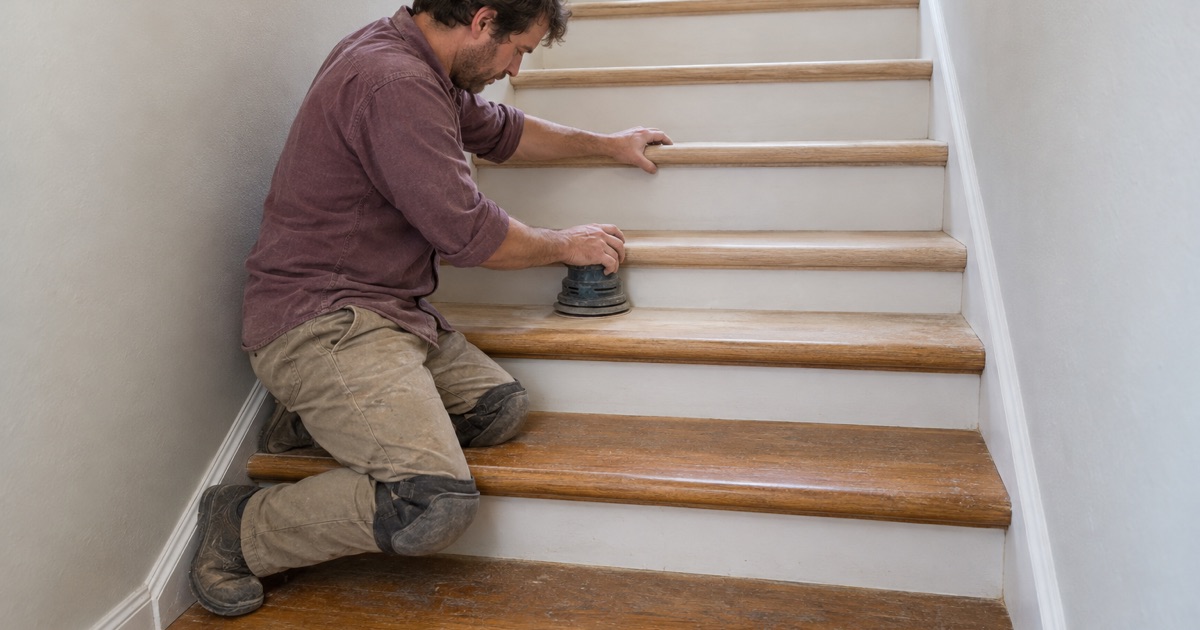
A drum sander cannot reach the steps of a staircase, so each tread, riser and nosing is sanded with smaller sanders and by hand. We work through a grit sequence on every surface, taking care around balusters, the skirt board and the rounded nosing.
Worn areas at the center of each tread, where feet land, often need more sanding than the edges. We check the thickness of each tread first, especially on older stairs that may have been sanded before, and replace any that are cracked or too thin.
Stain, Finish and Grip
Stair treads get stained to match the floor, then coated with waterborne polyurethane, oil-modified polyurethane or hardwax oil chosen to meet South Coast AQMD Rule 1113. Stairs take heavy wear, so we usually recommend an extra coat for durability.
A high-gloss finish can be slippery on stairs, especially in socks. Most households choose a satin or matte sheen level, which gives better grip and hides scuffs. Stair runners or treads with grip strips are also an option for homes with young children, older adults or pets.
Keeping the Stairs Usable
Stairs are refinished in stages when the household needs to use them. We can sand and coat alternate steps, finishing the others once the first set has cured, so there is always a safe way up and down. The written schedule shows which steps are ready and when.
Where a family can stay elsewhere for a short time, we can refinish the whole staircase at once, which shortens the job. We lay out both options so you can choose what suits your household.
- 20+ Years in Wood Floors
- Build Year Checked First
- Written Cure Schedules