
Upland Wood Flooring repairs hardwood floor water damage in Upland, CA, drawing on more than 20 years of wood floor work, serving surrounding cities including San Antonio Heights, Claremont, Montclair, Rancho Cucamonga and La Verne. We assess cupped, buckled and stained floors, confirm the moisture has been dealt with, and then repair or replace the boards that will not recover.
Water damage repair follows a strict order. The leak has to be found and fixed, the moisture readings have to come back within range, and only then do new boards go down. Skip any of those steps and the repair usually fails the same way the original floor did.
We also document the damage as we go. Water, smoke and ash damage is recorded room by room with photos, moisture readings and measurements, so the adjuster has a clear record and you have a written scope of what the floor needs.
How Water Damages a Wood Floor
Cupping, Crowning and Buckling
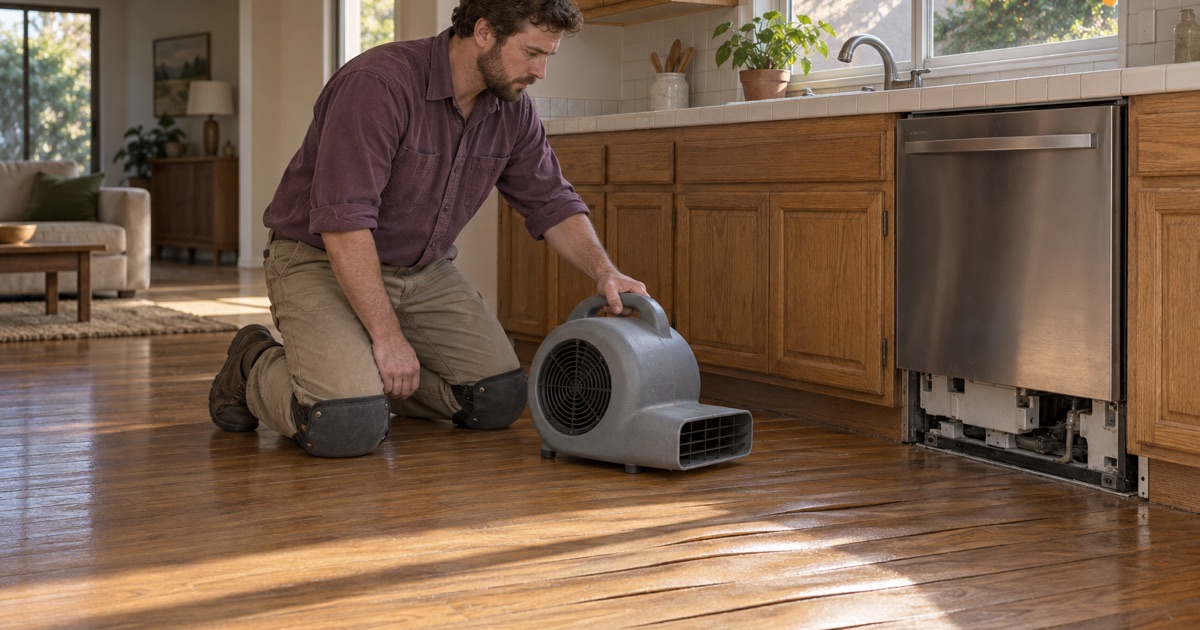
When water reaches the underside of a hardwood floor, the bottom of each board swells more than the top, and the edges rise into a cup. If a cupped floor is sanded flat while it is still wet, the centers later rise as the boards dry, which is crowning. Severe water pushes boards up off the subfloor entirely, which is buckling.
Each shape tells us something. Cupping means the moisture is still below the boards or recently was. Crowning usually means someone sanded too early. Buckling means the floor took in more water than it could handle, and those boards usually have to come out.
Stains and Board Damage
Water that sits on a floor or soaks through from below leaves stains. Light gray marks may sand out, but dark or black stains usually mean water has reacted with the wood deep into the board. Standing water can also lift the finish, leaving white clouding or peeling on the surface.
Wood can also split, delaminate or lose its bond to the subfloor after a soaking. On engineered flooring, delamination shows as the top layer separating from the core, and those boards cannot be repaired. We check each affected area board by board before deciding what can be saved.
Slab Leaks Under Wood Floors
A slab leak is a water line leaking inside the concrete slab beneath the floor. The water spreads under the flooring before anything shows at the surface. Common early signs are a warm spot underfoot from a hot water line, cupping in one area, a musty smell or a higher water bill.
Wood floors over slab leaks often fail from the bottom up, with the adhesive softening and the boards cupping. A plumber has to locate and repair the leak first. We then map the wet area with a moisture meter and plan the repair around how far the water spread.
The Order of a Water Damage Repair
Confirming the Leak Source
Before anything else, we confirm what caused the water and that it has been fixed. Common sources are supply lines to sinks and toilets, dishwashers, refrigerators with ice makers, water heaters, slab leaks and water coming in from outside. A repair over an active leak repeats the loss.
Where the cause is not obvious, the pattern of the damage helps. Water spreading from one wall points to a plumbing line, while damage near a door or along an exterior wall points to drainage or rain intrusion. We point the owner toward the right trade when the source is outside our work.
Moisture Readings and Drying
We take moisture meter readings across the damaged area and compare them with dry areas of the same floor. Those readings decide whether boards can dry in place and whether the subfloor or slab is ready for new wood. On a slab, we may also use in-situ relative humidity testing before gluing new boards down.
Drying is done with air movement and dehumidification, often by a water mitigation company. We keep checking readings until the wood and the subfloor are back within range. Only then do we decide which boards to replace and whether the rest of the floor can be sanded flat.
Replacing and Refinishing
Boards that are buckled, split, delaminated or stained through are cut out and replaced. New boards are matched to species, width and cut and woven into the old floor so the repair does not show as a square patch. Subfloor that has rotted or delaminated is replaced before new boards go in.
Once the repair is in, the whole affected room, or a run of floor to a natural break, is sanded and finished together. That evens out the color and sheen between old and new boards. We finish with products that meet South Coast AQMD Rule 1113 and leave a written cure schedule.
Water Damage and Insurance Claims
Documenting the Floor for the Adjuster
Claims go more smoothly with good records. We photograph the damaged areas, record moisture readings with their locations, measure the affected rooms and note the flooring type, species and thickness. That record is organized room by room so an adjuster can see what happened and what is needed.
We also note any damage caused by the work needed to reach a leak, such as flooring removed to repair a pipe. The written scope separates the boards damaged by water from the areas that need work for matching, so both are visible in the claim.
Matching and Continuous Floors
California’s claims regulation, 10 CCR 2695.9(a)(2), says replaced items should be of like kind and quality and reasonably uniform in appearance. On a hardwood floor, new boards may not match old ones that have aged and been refinished over the years, especially when the floor runs continuously through several rooms.
We describe where the floor is continuous, where a doorway or transition gives a natural break, and what it would take to make the repaired area look uniform. How that applies to your claim is between you and your insurer. Our job is to make the facts about the floor clear.
Smoke, Soot and Ash Damage
Water is not the only kind of damage a claim may cover. After a fire nearby or a wildfire, smoke and fine ash can settle into finishes and board joints, and firefighting water can soak floors. Light residue may clean and recoat, while heavier damage may need sanding or board replacement.
We document smoke, soot and ash damage the same way we document water: room by room, with photos and notes on the flooring type. That keeps the record consistent when a single event has caused more than one type of damage.
Preventing a Repeat
Protecting a Repaired Floor
Many water damage calls come from appliances and fixtures that can be protected. Braided supply lines, leak sensors under sinks and near water heaters, and regular checks on ice maker lines all reduce the risk. Wiping up spills promptly and using mats at sinks and entry doors help too.
A well-maintained finish also slows water from entering the wood. When a floor starts to look dull and worn at the kitchen and entry, a screen and recoat restores that protective layer before water can reach bare wood.
Early Signs Worth a Call
Water damage is cheaper to repair when it is caught early. Boards that start to cup near a sink, a dark line along a dishwasher, a musty smell in one room or a warm patch on a slab floor are all worth checking before they spread. A moisture meter reading takes minutes and tells us whether there is a problem under the surface.
If the reading is high, we help you trace the likely source and bring in the right trade. If it is normal, you have peace of mind and a baseline reading to compare against later. Either way, the floor gets attention while the fix is still small.
- 20+ Years in Wood Floors
- Build Year Checked First
- Written Cure Schedules